Back in the day, when dial up modems still existed, you would think nothing of waiting for a couple of minutes for a web page to load up.
Remember the anticipation as a picture you’d downloaded was revealed line by line? Miss those times? Me either!
Nowadays we live in an a rather more instant world. In fact, if a website takes more than a few seconds to load it can be irritating. As a result, the speed at which the pages on your website load can be a major factor in how successful it is. So, why is page speed so important?
Ultimately, customers prefer a faster browsing experience. If they don’t get one, they’ll go somewhere else. Successful websites create a great browsing experience for their customers and as a result are much more likely to convert browsers into buyers.
Just as importantly, website loading speeds actually affect your search engine ranking. Google (and we use Google as they account for 93% of browsing traffic) is all about directing search customers to the best websites for their needs. And as they understand that one of those needs is a pleasant browsing experience, that includes page loading speeds. They’ve even admitted this is a ranking factor!
In June 2021, Google released a core algorithm update called “Page Experience Update”. The whole point of the update was to prioritize pages that offered a ‘quality page performance’, meaning those with fast loading times and stable, non-shifting pages. So, any SEO agency worth their salt will factor in your websites page speed as one of the first things that they look at. It’s such an important element and yet largely overlooked, especially with older websites. And it’s one of the easiest ways of making big improvements to your site (if you know what you’re doing).
In terms of successful search engine optimisation (SEO), page speed is a biggie because improving loading times improves your search engine ranking, improves your browsing experience for your potential customers and as a result will improve your conversion rates. And THAT’s what SEO is all about! Don’t believe me? Here’s a few stats:
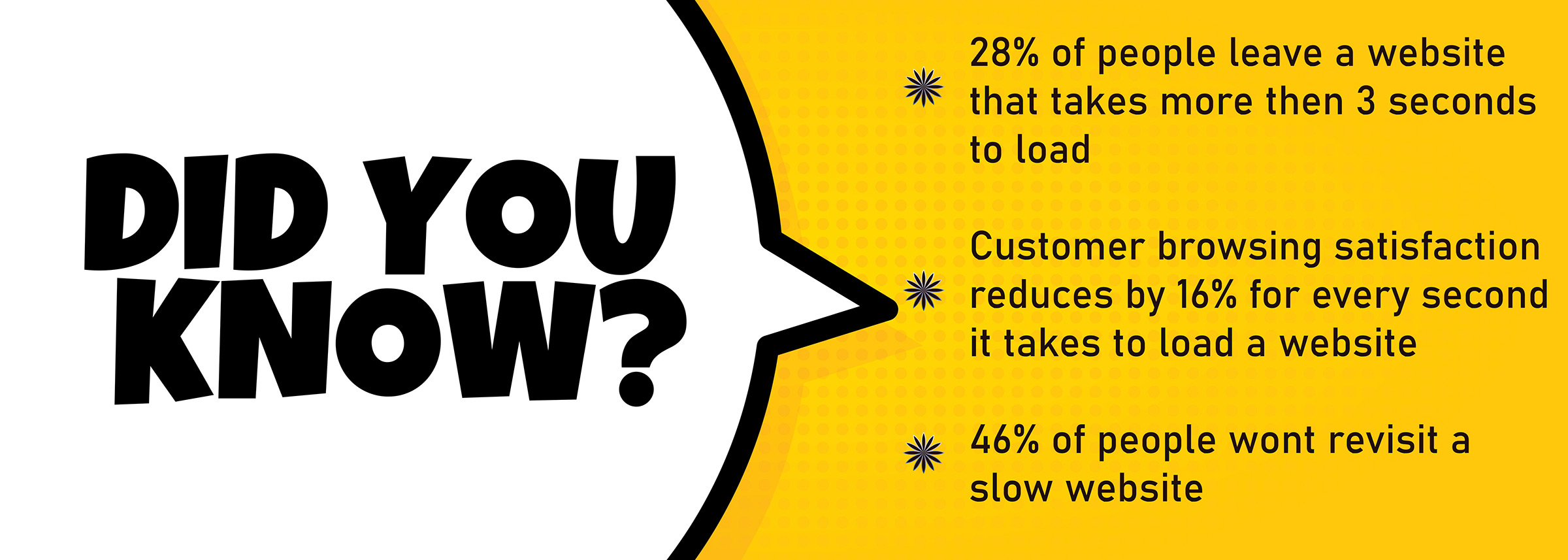
(Source – Kissmetrics).
Amazon were so concerned about this research that they tested it for themselves. They estimated that they would lose $1.6 billion a year if they slowed the site down by just 1 second! Page speed matters!
Put simply, it’s how fast the content of a website page takes to load.
More technically, it comprises two elements: ‘Page Load Time’ and ‘Time to First Byte’. What’s the difference?
Page Load Time – the length of time to fully display the content of a single website page.
Time to First Byte – how long a browser takes to receive the first byte of information from the web server.
Your website users are only consciously affected by page load time. Search engines, however, emphasis the performance of both measures and calculate your ranking score accordingly.
So, you need to concentrate on both elements to be search engine friendly. Let’s talk Bounce Rate. We mentioned earlier about conversion rates. Ideally you want customers that browse your website to become ‘buyers’. This means your site must be interesting and informative enough to hold their attention until they make a ‘purchase’ (sign up to your newsletter, book a service or buy a product).
Search engines measure how long each individual visitor spends on each page of your site. If users spend only a few seconds on a page this is not seen as a good thing. It means either the content was not what they were looking for, not easy to understand or navigate, too expensive or the page didn’t load faster enough (there are many other reasons, but these are the most common). So, these users are said to ‘bounce’ quickly and your page suffers from high bounce rate. As a result, search engines are less likely to send users to your page if someone else’s websites bounce rate is lower. Slow page speeds affect bounce rate which in turn affect your search engine rankings.
There are numerous factors that affect your website page speeds but there are some common factors that contribute to the biggest issues:
For those that don’t know, a web hosting company is the provider of the server that your website is hosted on. Web hosting sites will normally offer a couple of options for you to choose from. These include shared servers, Virtual Private Servers (VPS) or Dedicated Servers. The type you choose can have a huge influence on your page loading speeds.
Shared servers are the cheapest option as they share resources with other websites on that server. Unfortunately, they can offer much slower speeds and are commonly the cause of page load speed issues. If your web host (and server) don’t deliver the files on your website quickly, it wont matter how optimised they are! They can also cause headaches from a security perspective. If the web hosts shared server is compromised, then all websites on that shared server could be compromised. VPS and dedicated servers offer more bandwidth and you’re not sharing resources so page speeds will be improved, often drastically. Especially if you have a very large site. But this performance comes at a cost.
However, very few people look beyond cheaper packages when starting up a website. We know that page speed affects your search engine ranking, SEO and customer conversion rate. So, paying extra for a better web hosting with higher performing servers is actually a sound investment. Finally, having your server in the country you live in can also help to reduce page load speeds. Less time is needed to access the files due to the reduced distance between your customers and the host.
A cache is a specific storage space on your computer or device that’s used for storing temporary files. Your browser uses the cache to save a version of your web page so that the next time you visit it you won’t have to reload the entire page, hence improving the speed at which you can access it. There are numerous readily available plugins that can be used in your site to speed up your website loading speeds.

It stands to reason that the larger an image is on a web page, the longer it will take to load. Similarly, the more files on a page or the larger the files, the slower the speed. Hence optimising and minimizing image and file sizes can drastically reduce page load speeds. There are lots of compression tools and plugins that can assist with this. Or ensure that your images are optimised before uploading them to your site. Another quick win is ensuring the use of ‘responsive’ images. The browser will adapt the image relative to the size of the device, so it won’t try to load a desktop sized image on a mobile screen, for example.
Plugins are brilliant at enhancing and adding important functions to your website and many are available that are designed to decrease your page load speeds. But be warned. The more plugins you have on a page, the more likely it is that this will put a strain on the server and the slower the page will become. Reduce the number you use to just the basics and you’ll see big improvements in page load speeds.
The amount of code used in your website can impact page load speeds. Where possible, take the time to minify or compress your HTML, CSS and JavaScript to the smallest size (without altering how it works). Again, there are many tools available to help with this and can help to improve speeds. Problem arise when you are using an ‘off the shelf’ or free website building site (e.g. Wix or Squarespace). Although these are cheap and convenient, they are difficult to manipulate when it comes to the code so you’re going to suffer slower speeds because of using them. Getting a bespoke website allows for you to take control of these issues. In fact, a good web developer will be mindful of all these issues whilst building your site. So, you’ll be much less likely to have issues.

Lots of redirects on your website can slow down the user experience. This is an issue that is particularly prevalent in older websites. Updates and changes to the websites structure means the need to redirect users that visit older URLs to newer or updated versions of the page. The more users are redirected, the slower their interaction with the site. To ensure a faster browsing experience minimise the number of redirects in your site.
Content delivery networks (CDN’s) are similar in the way they work to caches. A version of your web page is stored in several different locations to enabled them to be accessed quicker than retrieving them from a single source. You will generally need to pay for this service but they’re great for large websites with lots of pages or products. Many large online shops find these particularly useful. So, as you can see, there are several different factors that affect your web page speeds (this list could go on). And as we’ve discussed, this has a direct influence on your users browsing experience and how search engines rank your site. So, it’s advisable to be aware if this is an issue on your website. How do you check your speeds then?
As you would expect for such an important factor, there are loads of tools to test your web page speeds. As Google places an emphasis on it as a ranking factor we use their Google Page Speed Insights tool. It’s free and gives you a breakdown of the elements affecting your speed as well as an overall score. As web developers and SEO specialists, the report it gives is very useful in indicating which issues need to be addressed. As most of the factors that we have discussed are quite technical in nature we would always advise you getting an expert to address them unless you are competent and confident enough to do so yourselves.
As a rule of thumb, you’re looking for page load speeds of less than 3 seconds to ensure you’re not adversely affecting your users browsing experience and for search engines to look upon your web pages favourably. And if you can get them faster than that, even better! If you’re worried that your website performance may be affecting how successful it is then why not get in contact with us. We can assess your site for you and let you know any improvements that can be made to improve its speed. As it’s about user experience it’s likely that this will become an even more important factor for your website in the coming months and years. So why not get ahead of the curve now and get that edge over your competition?